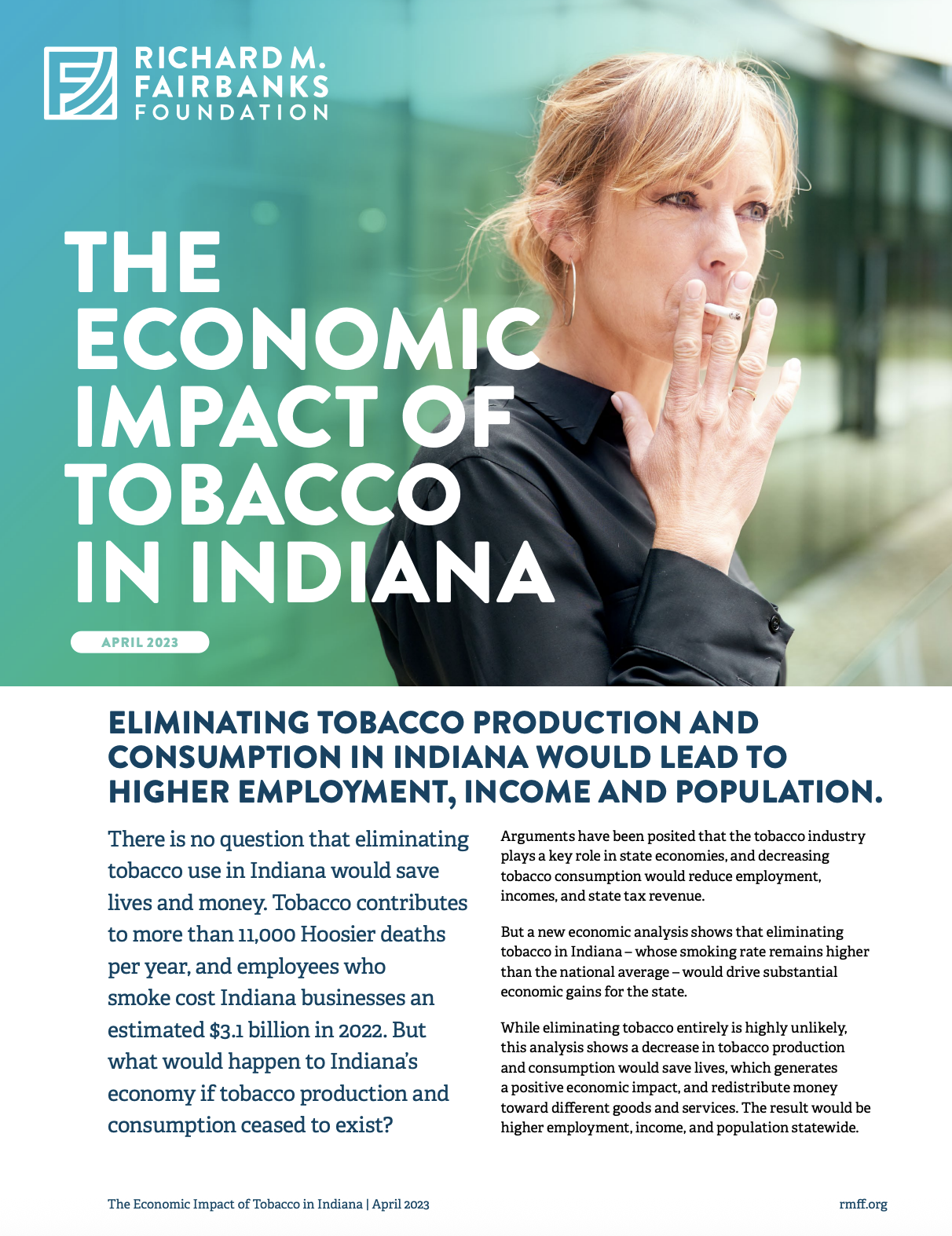
Reducing tobacco use would unquestionably save lives in Indiana, where the smoking rate remains higher than the national average. Decreasing tobacco consumption also would drive substantial economic gains in the state, including population growth, added jobs, and higher incomes.
The latest study commissioned by the Richard M. Fairbanks Foundation and developed by researchers at the University of Illinois Chicago projects that eliminating tobacco would lead to a more prosperous state. The researchers used a state-of-the-art macroeconomic model to project two versions of Indiana: one in which tobacco consumption stays at the status quo, and one in which tobacco use is eliminated altogether. The difference between the two shows the impact of tobacco on the state’s economy. While the complete elimination of tobacco in Indiana is unlikely, a decrease in tobacco production and consumption would still lead to positive health and economic outcomes.
The findings focused on three key economic drivers: employment, income, and population. Decreasing tobacco would have a positive impact on all three by saving lives, which leads to positive economic impacts, and shifting spending from tobacco to different goods and services.
Specific findings include:
- Employment: In the first year that tobacco is eliminated, there would be a projected increase of 2,661 jobs, a figure that would grow to 13,879 after 20 years.
- Disposable Personal Income: An increase in wages and salaries would lead to higher incomes in a tobacco-free Indiana, with an increase of $302 million in the first year. After 20 years, Hoosiers’ collective income would be $1.6 billion higher.
- Population: Fewer deaths would drive population growth, and because Indiana would be a more attractive place to live and work without smoking, the state would benefit from an in-migration of workers and employers. The population would grow by 1,824 people in the first year of a tobacco-free Indiana and by 25,217 people after 20 years.
Despite arguments that eliminating tobacco would hurt the economy, quite the opposite is true. Indiana would see a substantial growth in jobs, incomes, and people if tobacco were eliminated, leading to a more prosperous state.